
Chevrolet Cruze Repair Manual: Air Hose Test
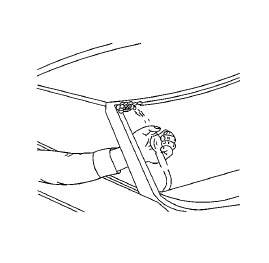
Caution: The air hose test should only be used on fully cured urethane adhesive. Otherwise, damage to the urethane adhesive bead could result in additional leaks.
- Using a liquid detergent, diluted with water in a spray bottle, spray the window at the edges. Begin at the bottom and gradually move up and across the top.
Note: The compressed air should not exceed 205 kPa (30 psi).
- Have an assistant inside of the vehicle with an air hose.
- Have the assistant aim the compressed air at the suspected areas.
Bubbles will form in the soap solution at the location of the leak.
 Water Hose Test
Note: Use a water hose without the nozzle attached.
Have an assistant inside of the vehicle i 1. n order to locate the leak.
Begin testing at the base of the window or the windshield.
Slow ...
 Body Waterleak Repair
Warning: If the vehicle interior is exposed to moisture and becomes
soaked up to the level of the sensing and diagnostic module (SDM),
the SDM and SDM harness connector must be replaced. The SD ...
Other materials:
Intermediate Steering Shaft Replacement
Removal Procedure
Turn the steering wheel to the straight forward position and support it
from movement
Remove the 2 intermediate steering shaft bolts (1).
Remove the intermediate steering shaft (1).
Installation Procedure
Install the intermediate steering shaft ...
Front Side Door Replacement
Preliminary Procedure
Remove the front side door trim panel. Refer to Front Side Door Trim
Replacement.
Front Side Door Check Link Bolt
Caution: Refer to Fastener Caution in the Preface section.
Procedure
Remove the water deflector.
Disconnect the door electrical connector.
Su ...
Rear Compartment Lid Emblem/Nameplate Replacement (VCDi AT)
Rear Compartment Lid Emblem Assembly
Caution: Refer to Exterior Trim Emblem Removal Caution in the
Preface section.
Procedure
The part and surface should be 21°C (70°F) prior to installation. The
vehicle should remain 21°C (70°F) for
one hour after assembly to allow adhesive to deve ...
