
Chevrolet Cruze Owners Manual: Recreational Vehicle Towing
Recreational vehicle towing refers to towing the vehicle behind another vehicle – such as behind a motor home. The two most common types of recreational vehicle towing are known as dinghy towing and dolly towing. Dinghy towing is towing the vehicle with all four wheels on the ground. Dolly towing is towing the vehicle with two wheels on the ground and two wheels up on a device known as a dolly.
Here are some important things to consider before recreational vehicle towing: • The towing capacity of the towing vehicle. Be sure to read the tow vehicle manufacturer's recommendations.
• How far the vehicle will be towed. Some vehicles have restrictions on how far and how long they can tow.
• The proper towing equipment.
See your dealer or trailering professional for additional advice and equipment recommendations.
• If the vehicle is ready to be towed. Just as preparing the vehicle for a long trip, make sure the vehicle is prepared to be towed.
Dinghy Towing (With Automatic Transmission)
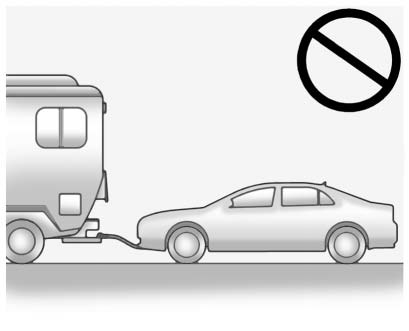
Notice: If the vehicle is towed with all four wheels on the ground, the drivetrain components could be damaged.
The repairs would not be covered by the vehicle warranty. Do not tow the vehicle with all four wheels on the ground.
Vehicles with an automatic transmission should not be towed with all four wheels on the ground.
If the vehicle must be towed, a dolly should be used. See "Dolly Towing" that follows for more information.
Dinghy Towing (With Manual Transmission)
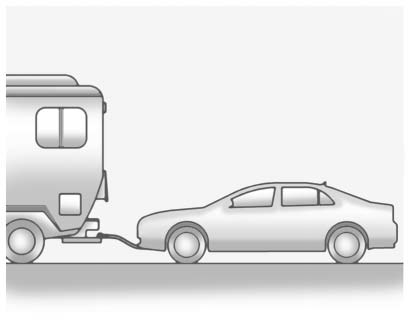
To dinghy tow the vehicle from the front with all four wheels on the ground: 1. Position the vehicle to tow and then secure it to the towing vehicle.
2. Shift the transmission to Neutral.
3. Turn the ignition to ACC/ ACCESSORY.
4. To prevent the battery from draining while the vehicle is being towed, remove fuse 22, 23, 24, and 25 from the instrument panel fuse block.
Remember to reinstall the fuses once the destination has been reached.
Notice: If 105 km/h (65 mph) is exceeded while towing the vehicle, it could be damaged.
Never exceed 105 km/h (65 mph) while towing the vehicle.
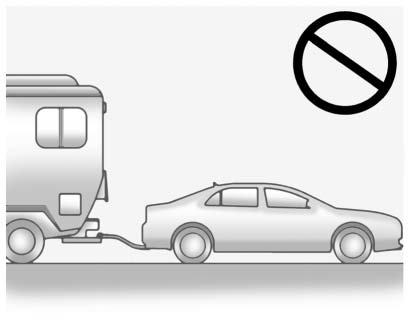
Notice: Towing the vehicle from the rear could damage it. Also, repairs would not be covered by the vehicle warranty. Never have the vehicle towed from the rear.
Dolly Towing
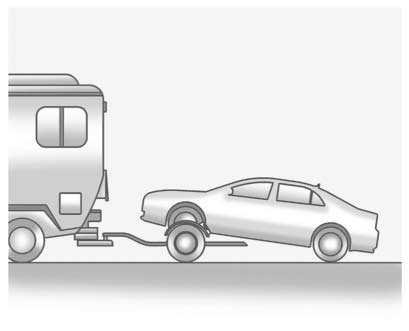
Tow the vehicle with the two rear wheels on the ground and the front wheels on a dolly: To tow the vehicle with two wheels on the ground and a dolly: 1. Put the front wheels on a dolly.
2. Shift the automatic transmission into P (Park) or a manual transmission into 1 (First) gear.
3. Set the parking brake.
4. Clamp the steering wheel in a straight-ahead position with a clamping device designed for towing.
5. Remove the key from the ignition.
6. Secure the vehicle to the dolly.
7. Release the parking brake.
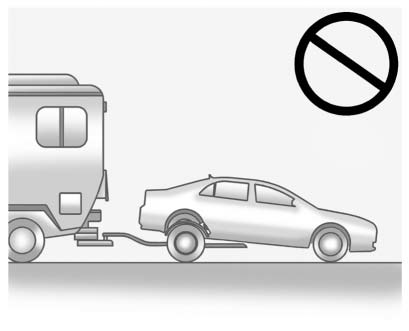
Notice: Towing the vehicle from the rear could damage it. Also, repairs would not be covered by the vehicle warranty. Never have the vehicle towed from the rear.
 Towing the Vehicle
Notice: Incorrectly towing a disabled vehicle may cause damage. The
damage would not be covered by the vehicle warranty. Do not lash or hook to the
chassis components including the front and rear ...
 Appearance Care
...
Other materials:
Navigation Symbols
Following are the most common symbols that appear on a map screen.
The vehicle symbol indicates the current position and heading direction of the
vehicle on the map.
The destination symbol marks the final destination after a route has been planned.
The waypoint symbol marks one or more se ...
Removal Procedure
Warning: Refer to Approved Equipment for Collision Repair Warning in the
Preface section.
Warning: Refer to Glass and Sheet Metal Handling Warning in the Preface section.
Disable the SIR System. Refer to SIR
Disabling and Enabling.
Disconnect the negative battery cable. Refer to ...
Loss of Control
Skidding
There are three types of skids that correspond to the vehicle's three control
systems:
• Braking Skid — wheels are not rolling.
• Steering or Cornering Skid — too much speed or steering in a curve causes tires
to slip and lose cornering force.
• Acceleration Skid — too much thro ...
