
Chevrolet Cruze Owners Manual: Doors
Trunk
WARNING
Exhaust gases can enter the vehicle if it is driven with the liftgate, trunk/hatch open, or with any objects that pass through the seal between the body and the trunk/hatch or liftgate. Engine exhaust contains carbon monoxide (CO) which cannot be seen or smelled. It can cause unconsciousness and even death.
If the vehicle must be driven with the liftgate, or trunk/hatch open: • Close all of the windows.
• Fully open the air outlets on or under the instrument panel.
• Adjust the climate control system to a setting that brings in only outside air and set the fan speed to the highest setting. See “Climate Control Systems” in the Index.
• If the vehicle has a power liftgate, disable the power liftgate function.
Remote Trunk Release
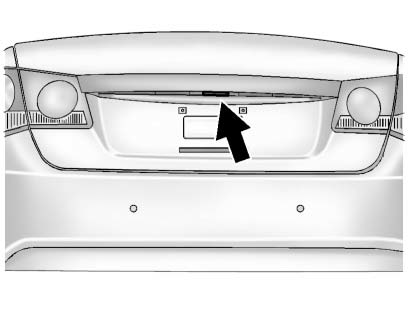
To open the trunk from outside the vehicle, press the button on the Remote Keyless Entry (RKE) transmitter, or by pressing the touch pad
above the license plate when the doors are unlocked.
button on the Remote Keyless Entry (RKE) transmitter, or by pressing the touch pad
above the license plate when the doors are unlocked.
If the engine is running, the doors must be unlocked. Vehicles with an automatic transmission must be in P (Park), vehicles with a manual transmission must have the park brake applied.
Emergency Trunk Release Handle
Notice: Do not use the emergency trunk release handle as a tie-down or anchor point when securing items in the trunk as it could damage the handle.
The emergency trunk release handle is only intended to aid a person trapped in a latched trunk, enabling them to open the trunk from the inside.
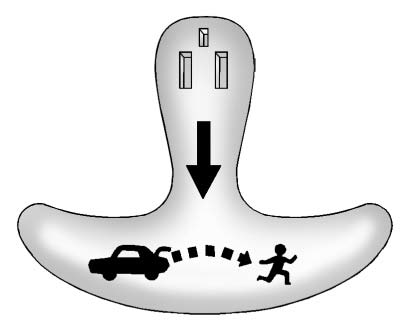
There is an emergency trunk release handle located inside the trunk on the trunk lid. The release handle can be accessed by folding the rear seatback. Pull the release handle to open the trunk from the inside.
 Safety Locks
The rear door safety locks prevent passengers from opening the rear doors from
inside the vehicle.
Press to activate the safety locks.
The indicator light comes on when activated.
The rear do ...
 Vehicle Security
This vehicle has theft-deterrent features; however, they do not make the vehicle
impossible to steal. ...
Other materials:
Rear Compartment Lid Weatherstrip Replacement
Rear Compartment Lid Weatherstrip
Procedure
Start at the upper corner of the rear compartment opening and pull the
weatherstrip away from the rear
compartment opening flange.
Position the weatherstrip in the upper corner of the r 2. ear
compartment opening.
Working downward alon ...
Ultrasonic Parking Assist
The Ultrasonic Rear Parking Assist (URPA) system assists the driver with parking
and avoiding objects while in R (Reverse). URPA operates at speeds less than 8 km/h
(5 mph). The sensors on the rear bumper detect objects up to 2.5m (8 ft) behind
the vehicle, and at least 20 cm (8 in) off the gr ...
Power Outlets
The accessory power outlets can be used to plug in electrical equipment, such
as a cell phone or MP3 player.
There is one accessory power outlet located on the center floor console and one
on the rear of the center floor console. These outlets are powered when the key
is in ON/ RUN or ACC/ACC ...
