
Chevrolet Cruze Owners Manual: Older Children
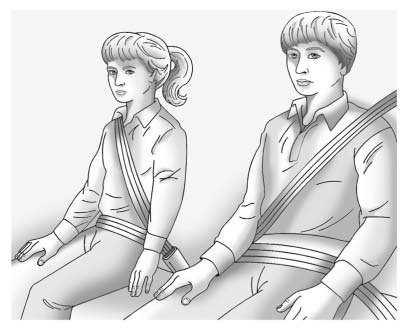
Older children who have outgrown booster seats should wear the vehicle safety belts.
The manufacturer instructions that come with the booster seat state the weight and height limitations for that booster. Use a booster seat with a lap-shoulder belt until the child passes the fit test below: • Sit all the way back on the seat.
Do the knees bend at the seat edge? If yes, continue. If no, return to the booster seat.
• Buckle the lap-shoulder belt.
Does the shoulder belt rest on the shoulder? If yes, continue.
If no, try using the rear safety belt comfort guide. If the shoulder belt still does not rest on the shoulder, then return to the booster seat.
• Does the lap belt fit low and snug on the hips, touching the thighs? If yes, continue. If no, return to the booster seat.
• Can proper safety belt fit be maintained for the length of the trip? If yes, continue. If no, return to the booster seat.
Q: What is the proper way to wear safety belts?
A:
An older child should wear a lap-shoulder belt and get the additional restraint a shoulder belt can provide. The shoulder belt should not cross the face or neck. The lap belt should fit snugly below the hips, just touching the top of the thighs.
This applies belt force to the child's pelvic bones in a crash.
It should never be worn over the abdomen, which could cause severe or even fatal internal injuries in a crash.
According to accident statistics, children and infants are safer when properly restrained in a child restraint system or infant restraint system secured in a rear seating position.
In a crash, children who are not buckled up can strike other people who are buckled up, or can be thrown out of the vehicle. Older children need to use safety belts properly.
WARNING
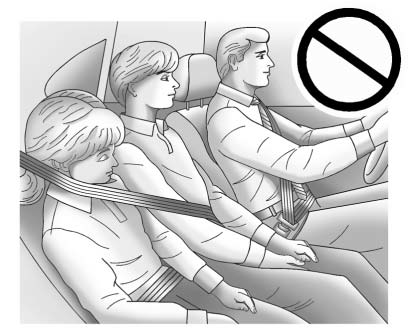
Never allow more than one child to wear the same safety belt. The safety belt cannot properly spread the impact forces. In a crash, they can be crushed together and seriously injured. A safety belt must be used by only one person at a time.
WARNING
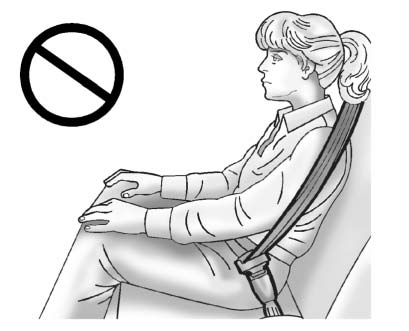
Never allow a child to wear the safety belt with the shoulder belt behind their back. A child can be seriously injured by not wearing the lap-shoulder belt properly. In a crash, the child would not be restrained by the shoulder belt.
The child could move too far forward increasing the chance of head and neck injury. The child might also slide under the lap belt. The belt force would then be applied right on the abdomen.
That could cause serious or fatal injuries. The shoulder belt should go over the shoulder and across the chest.
 Child Restraints
...
 Infants and Young Children
Everyone in a vehicle needs protection! This includes infants and all other children.
Neither the distance traveled nor the age and size of the traveler changes the need,
for everyone, to use safe ...
Other materials:
Installation Procedure
Align the body side outer panel reinforcement.
Clean and prepare the attaching surfaces for welding.
Position the body side outer panel
reinforcement on the vehicle.
Verify the fit of the body side outer panel reinforcement.
Clamp the body side outer panel reinforcement ...
Radio Data System (RDS)
RDS features are available for use only on FM stations that broadcast RDS information.
With RDS, the radio can:
• Seek to stations broadcasting the selected type of programming.
• Receive announcements concerning local and national emergencies.
• Display messages from radio stations.
Thi ...
Removal Procedure
Warning: Refer to Approved Equipment for Collision Repair Warning in the
Preface section.
Warning: Refer to Collision Sectioning Warning in the Preface section.
Warning: Refer to Glass and Sheet Metal Handling Warning in the Preface section.
Disable the SIR System. Refer to SIR Dis ...
