
Chevrolet Cruze Owners Manual: Traction Control System (TCS)
The vehicle has a Traction Control System (TCS) that limits wheel spin.
On a front-wheel-drive vehicle, the system operates if it senses that one or both of the front wheels are spinning or beginning to lose traction. When this happens, the system brakes the spinning wheel(s), and/or reduces engine power to limit wheel spin.
The system may be heard or felt while it is working, but this is normal.
TCS is on whenever the vehicle is started. To limit wheel spin, especially in slippery road conditions, the system should always be left on. But, TCS can be turned off if needed.

TCS/StabiliTrak Light
 flashes to indicate that the traction
control system is active.
flashes to indicate that the traction
control system is active.
If there is a problem detected with TCS, SERVICE TRACTION CONTROL and SERVICE STABILITRAK may be displayed on the Driver Information Center (DIC).
When this message is displayed and d comes on and stays on, the vehicle is safe to drive but the system is not operational.
Driving should be adjusted accordingly.
If  comes on and stays on, reset the
system:
comes on and stays on, reset the
system:
1. Stop the vehicle.
2. Turn the engine off and wait 15 seconds.
3. Start the engine.
If  still comes on and stays on at
a speed above 20 km/h (13 mph), see your dealer for service.
still comes on and stays on at
a speed above 20 km/h (13 mph), see your dealer for service.
A chime may also sound when the light comes on steady.
Notice: Do not repeatedly brake or accelerate heavily when TCS is off. The vehicle's driveline could be damaged.
TCS/StabiliTrak Button
 is located on the console.

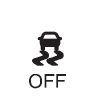
TCS Off Light
TCS can be turned off by pressing and releasing
 . When TCS is turned off,
 comes on and the system will not limit
wheel spin.
comes on and the system will not limit
wheel spin.
Driving should be adjusted accordingly. Press and release
 again to turn the system back on.
It may be necessary to turn the system off if the vehicle gets stuck in sand, mud, or snow and rocking the vehicle is required. If cruise control is being used when TCS activates, cruise control will automatically disengage. Press the cruise control button to reengage when road conditions allow.Adding non-GM accessories can affect the vehicle's performance.

 StabiliTrak® System
The vehicle has a vehicle stability enhancement system called StabiliTrak. It
is an advanced computer controlled system that assists with directional control
of the vehicle in difficult driving co ...
Other materials:
Air Conditioning Compressor Replacement (1.6L LXT)
Preliminary Procedures
Recover the refrigerant. Refer to Refrigerant Rec overy and
Recharging.
Remove drive belt. Refer to Generator and Air Conditioning Compressor
and Power Steering Pump Belt Replacement.
Raise and support the vehicle. Refer to Lifting and Jacking the Vehic ...
Storing the Tire Sealant and Compressor Kit
The tire sealant and compressor kit is located in the trunk, under the load floor,
behind an access panel.
To remove the kit:
1. Open the trunk.
2. Turn the left knob counterclockwise and the right knob clockwise, 90 degrees,
at the same time. Then pull the access panel rearward and up to r ...
Installation Procedure
Apply structural adhesive on the flanges of the rear side door inner
panel where the rear side door outer panel bears on.
Align the rear side door outer panel.
Verify the fit of the rear side door outer panel.
Clamp the rear side door outer panel
into position.
Pre-fla ...
