
Chevrolet Cruze Repair Manual: Variable Effort Steering System Description and Operation
The Variable Effort Steering (VES) system or MAGNASTEER® varies the amount of effort required to steer the vehicle as vehicle speed changes. At low speeds, the system provides minimal steering effort for easy turning and parking maneuvers. Steering effort is increased at higher speeds to provide firmer steering (road feel) and directional stability. VES works in parallel with the base torsion bar in the power steering system.
The VES control module communicates on the high speed bus and uses vehicle speed and the steering wheel angle speed to command a current that is most appropriate for each speed to the VES actuator in the steering rack and pinion. The actuator is a variable electromagnetic actuator, which consists of one multiple-pole ring-style permanent magnet, with a pole piece, and an electromagnetic coil assembly on each side. By commanding currents between -3 to +3 Amps through the coils the steering effort will be adapted to the vehicle’s speed.
At lowest speed, around 5 km/h (3 mph) the coils are polarized in such a way that the magnetic forces are repelling each others and hardly any effort is required to turn the ring magnet between them.
At mid speed, around 70 km/h (45 mph), no current is sent through the coils and steering is assisted by hydraulics only. At high speeds the coils are polarized in such a way that the magnetic forces are attracting each others and high effort is required to turn the ring magnet between them.
The VES control module communicates on the HS GMLAN bus.
The VES control module has the ability to detect malfunctions in the actuator. Any malfunctions detected will cause the system to ramp to zero amps. Steering will be assisted by hydraulics only and a DTC is set.
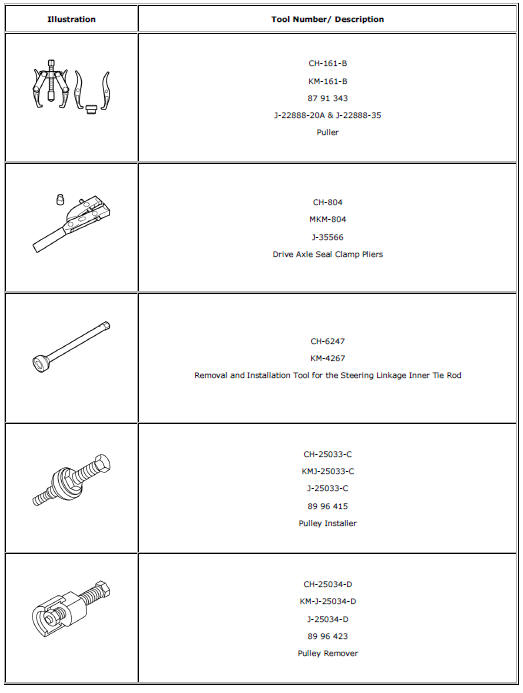
Special Tools and Equipment
 Power Steering System Description and Operation
The hydraulic power steering pump is a constant displacement vane-type pump
that provides hydraulic pressure and flow for the power
steering gear. The hydraulic power steering pumps are either belt ...
 Steering Wheel and Column
Specifications
...
Other materials:
Passenger Sensing System
United States
Canada
The passenger sensing system turns off the front outboard passenger frontal airbag
and knee airbag under certain conditions. No other airbag is affected by the passenger
sensing system.
The passenger airbag status indicator will be visible on the instrument panel
wh ...
Battery Voltage and Charging Messages
BATTERY SAVER ACTIVE
This message displays when the vehicle has detected that the battery voltage
is dropping beyond a reasonable point. The battery saver system starts reducing
features of the vehicle that may be noticed. At the point that features are disabled,
this message displays. Turn o ...
Rear Seat Back Cushion Cover and Pad Replacement - Left Side
Preliminary Procedure
Remove rear seat - left side. Refer to Rear Seat Replacement
Rear Seat Back Cushion Cover
Procedure
Remove the staples from the seat back cover.
Remove seat back cushion cover from Velcro.
Rear Seat Back Cushion Pad
Rear Seat Back Cushion Cover and Pad Re ...
