
Chevrolet Cruze Owners Manual: Fuel Gauge
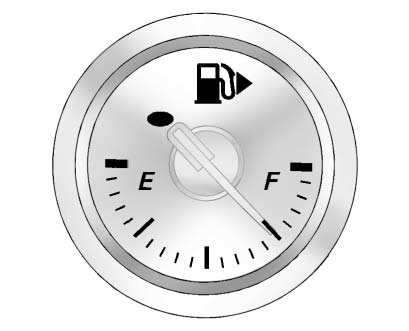
When the ignition is on, the fuel gauge indicates about how much fuel is left in the tank.
An arrow on the fuel gauge indicates the side of the vehicle the fuel door is on.
A FUEL LEVEL LOW message may appear in the Driver Information Center (DIC) and a single chime sounds.
Here are four things that some owners ask about. None of these show a problem
with the fuel gauge:
• At the service station, the fuel pump shuts off before the gauge reads full.
• It takes a little more or less fuel to fill up than the gauge indicated. For example, the gauge may have indicated the tank was half full, but it actually took a little more or less than half the tank's capacity to fill the tank.
• The gauge moves a little while turning a corner or speeding up.
• The gauge takes a few seconds to stabilize after the ignition is turned on, and will go back to empty when the ignition is turned off.
 Tachometer
The tachometer displays the engine speed in revolutions per minute (rpm).
Notice: If the engine is operated with the tachometer in the shaded
warning area, the vehicle could be damaged, and the dam ...
 Engine Coolant Temperature Gauge
This gauge shows the engine coolant temperature.
If the indicator needle moves to the hot side of the gauge toward the H or shaded
area, the engine is too hot.
If the vehicle has been operated u ...
Other materials:
Scheduling Service Appointments
When the vehicle requires warranty service, contact your dealer and request an
appointment. By scheduling a service appointment and advising the service consultant
of your transportation needs, your dealer can help minimize your inconvenience.
If the vehicle cannot be scheduled into the service ...
Removal Procedure
Warning: Refer to Approved Equipment for Collision Repair Warning in the
Preface section.
Warning: Refer to Glass and Sheet Metal Handling Warning in the Preface section.
Disable the SIR System. Refer to SIR
Disabling and Enabling.
Disconnect the negative battery cable. Refer to ...
Removal Procedure
Warning: Refer to Approved Equipment for Collision Repair Warning in the
Preface section.
Warning: Refer to Glass and Sheet Metal Handling Warning in the Preface section.
Disable the SIR System. Refer to SIR Disabling and Enabling.
Disconnect the negative battery cable. Refer to Bat ...
