
Chevrolet Cruze Owners Manual: Tire Designations
Tire Size
The following is an example of a typical passenger vehicle tire size.
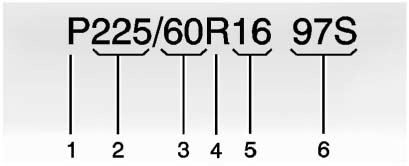
(1) Passenger (P-Metric) Tire:
The United States version of a metric tire sizing system. The letter P as the first character in the tire size means a passenger vehicle tire engineered to standards set by the U.S. Tire and Rim Association.
(2) Tire Width:
The three-digit number indicates the tire section width in millimeters from sidewall to sidewall.
(3) Aspect Ratio:
A two-digit number that indicates the tire height-to-width measurements.
For example, if the tire size aspect ratio is 60, as shown in item 3 of the illustration, it would mean that the tire's sidewall is 60 percent as high as it is wide.
(4) Construction Code:
A letter code is used to indicate the type of ply construction in the tire.
The letter R means radial ply construction; the letter D means diagonal or bias ply construction; and the letter B means belted-bias ply construction.
(5) Rim Diameter:
Diameter of the wheel in inches.
(6) Service Description:
These characters represent the load index and speed rating of the tire. The load index represents the load carrying capacity a tire is certified to carry. The speed rating is the maximum speed a tire is certified to carry a load.
 Tire Sidewall Labeling
Useful information about a tire is molded into its sidewall. The examples show
a typical passenger vehicle tire and a compact spare tire sidewall.
Passenger (P-Metric) Tire Example
(1) Tire Size ...
 Tire Terminology and Definitions
Air Pressure: The amount of air inside the tire pressing outward on each
square inch of the tire. Air pressure is expressed in kPa (kilopascal) or psi (pounds
per square inch).
Accessory Weight: ...
Other materials:
Removal Procedure
Warning: Refer to Approved Equipment for Collision Repair Warning in the
Preface section.
Warning: Refer to Collision Sectioning Warning in the Preface section.
Warning: Refer to Glass and Sheet Metal Handling Warning in the Preface section.
Disable the SIR System. Refer to SIR Dis ...
AM-FM Radio
Control Buttons
The buttons used to control the radio are: BAND: Press to turn the radio
on and choose between AM, FM, and SiriusXM®, if equipped.
MENU/SEL: Turn to navigate the available menus and to search for stations.
INFO: Press to display additional information that may be available for
...
Outback Gets Turbo Boost and XT Badge Returns in Australia
Subaru Australia is giving the 2023 Outback a shot of adrenaline with the introduction of the turbocharged Outback XT. This new variant injects a much-needed dose of power into the popular wagon, addressing the loss of the 3.6-liter engine from the previous generation.
Under the hood of the car ...
