
Chevrolet Cruze Owners Manual: How to Wear Safety Belts Properly
This section is only for people of adult size.
There are special things to know about safety belts and children. And there are different rules for smaller children and infants. If a child will be riding in the vehicle.
Follow those rules for everyone's protection.
It is very important for all occupants to buckle up. Statistics show that unbelted people are hurt more often in crashes than those who are wearing safety belts.
There are important things to know about wearing a safety belt properly.
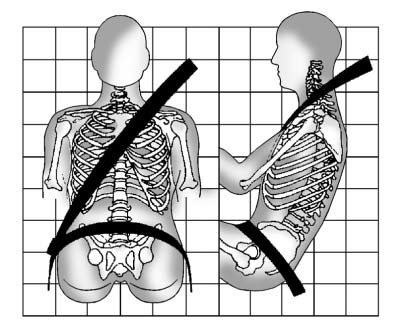
• Sit up straight and always keep your feet on the floor in front of you.
• Always use the correct buckle for your seating position.
• Wear the lap part of the belt low and snug on the hips, just touching the thighs. In a crash, this applies force to the strong pelvic bones and you would be less likely to slide under the lap belt. If you slid under it, the belt would apply force on your abdomen. This could cause serious or even fatal injuries.
• Wear the shoulder belt over the shoulder and across the chest.
These parts of the body are best able to take belt restraining forces. The shoulder belt locks if there is a sudden stop or crash.
WARNING
You can be seriously injured, or even killed, by not wearing your safety belt properly.
• Never allow the lap or shoulder belt to become loose or twisted.
• Never wear the shoulder belt under both arms or behind your back.
• Never route the lap or shoulder belt over an armrest.
 Safety Belts
This section of the manual describes how to use safety belts properly. It also
describes some things not to do with safety belts.
WARNING
Do not let anyone ride where a safety belt cannot be worn ...
 Lap-Shoulder Belt
All seating positions in the vehicle have a lap-shoulder belt.
The following instructions explain how to wear a lap-shoulder belt properly.
1. Adjust the seat, if the seat is adjustable, so you can ...
Other materials:
Installation Procedure
Cut the rear side rail in corresponding locations to fit the remaining
original panel. The sectioning joint should be trimmed to allow a
gap of one-and-one-half-times the metal thickness at the sectioning joint.
Create a 50 mm (2 in) backing plate from the unused portion of the
serv ...
Instrument Panel Fuse Block
The instrument panel fuse block is in the driver side of the instrument panel.
To access the fuses:
1. Open the fuse block cover by pulling out at the top.
2. Remove the lower edge of the cover.
3. Remove the cover.
To reinstall the cover, reverse the steps above.
Instrument Panel Fuse Bl ...
Instrument Panel
Instrument Panel Overview
1. Exterior Lamp Controls
Front Fog Lamps
Instrument Panel Illumination Control
2. Air Vents
3. Headlamp High/Low-Beam Changer
Turn Signal Lever.
Driver Information Center (DIC) Buttons.
4. Instrument Cluster
5. Driver Information Center (DIC)
6. Steering Wheel ...
