
Chevrolet Cruze Repair Manual: SIR Identification Views
The SIR Identification Views shown below illustrate the approximate location of all SIR components available for the vehicle. This will assist in determining the appropriate SIR Disabling and Enabling for a given service procedure, refer to SIR Disabling and Enabling.
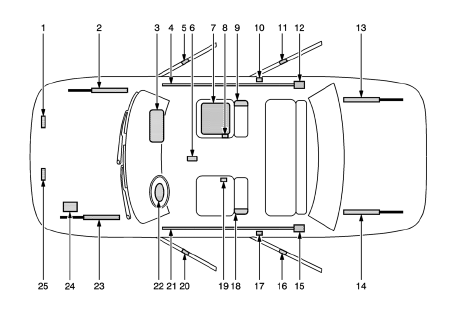
- Front End Sensor--Located under the hood at the front right side of the vehicle
- Front Hood Assist Rod--A gas shock located under the front hood on the passenger side
- I/P Air Bag--Located at the top right under the instrument panel
- Roof Rail Air Bag--Located under the headliner, extending from the passenger front windshield pillar to the passenger rear windshield pillar
- Right Front Side Impact Sensor (SIS)--Located behind the door panel on the right front passenger door
- Sensing and Diagnostic Module (SDM)--Located underneath the center console
- Passenger Presence System (PPS)--Located on the passenger front seat underneath the seat bottom trim
- Seat Belt Pretensioner--Located under the passenger front seat on the left rear side
- RF Side Impact Air Bag--Located on the seat back of passenger seat
- Seat Belt Retractor Pretensioner--Located under the trim near the bottom of the center pillar on the passenger side of vehicle
- Right Rear Side Impact Sensor (SIS)--Located behind the door panel on the right rear passenger door
- Inflator Module for Roof Rail Air Bag--Located behind the garnish molding on the upper rear pillar
- Rear Hood Assist Rod--A gas shock located under the rear truck lid on the passenger side
- Rear Hood Assist Rod--A gas shock located under the rear truck lid on the driver side
- Inflator Module for Roof Rail Air Bag--Located behind garnish molding on the upper rear pillar
- Left Rear Side Impact Sensor (SIS)--Located behind the door panel on the left rear passenger door
- Seat Belt Retractor Pretensioner--Located under the trim near the bottom of the center pillar on the driver side of vehicle
- LF Side Impact Air Bag--Located on the seat back of driver seat
- Seat Belt Pretensioner--Located under the driver front seat on the right rear side
- Left Front Side Impact Sensor (SIS)--Located behind the door panel on the left front driver door
- Roof Rail Air Bag--Located under the headliner, extending from the driver front windshield pillar to the driver rear windshield pillar
- Steering Wheel Air Bag--Located on the steering wheel
- Front Hood Assist Rod--A gas shock located under the front hood on the driver side
- Vehicle Battery--Located under the hood on the left side
- Front End Sensor--Located under the hood at the front left side of the vehicle
 Restraints
Specifications
Module Power, Ground, and MIL
Front Impact Sensor, Retractors, and Driver/Passenger Air
Bags
Side Impact Sensors and Side/Roof Air Bags
Air Bag Indicator and Disab ...
 SIR Service Precautions
SIR Service Precautions
Warning: When performing service on or near the SIR components or
the SIR wiring, the SIR system must be disabled. Failure to observe
the correct procedure could cause depl ...
Other materials:
Fuel Tank Filler Pipe Housing Replacement
Preliminary Procedure
Remove rear wheelhouse panel liner. Refer to Rear Wheelhouse Panel Liner
Replacement.
Remove fuel tank filler door. Refer to Fuel Tank Filler Door
Replacement.
Fuel Tank Filler Door Lock Actuator
Procedure
Disconnect electrical connector.
Fuel Tank ...
Front Seat Cushion Cover and Pad Replacement
Removal Procedure
Warning: Refer to SIR Warning in the Preface section.
Warning: Replace the passenger presence system as a complete assembly to prevent
possible injury to the occupant. The bladder, the
pressure sensor, the seat cushion, and the control module are assembled and
calibrated a ...
Tires
Every new GM vehicle has high-quality tires made by a leading tire manufacturer.
See the warranty manual for information regarding the tire warranty and where to
get service. For additional information refer to the tire manufacturer.
WARNING
• Poorly maintained and improperly used
tires are ...
