
Chevrolet Cruze Repair Manual: Rear Side Door Stationary Window Replacement
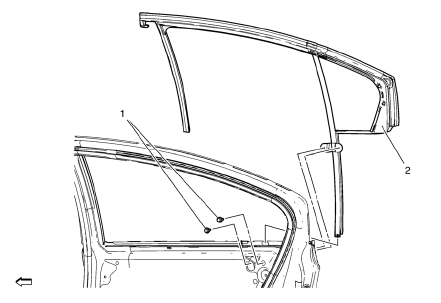
Preliminary Procedures
- Remove the rear side door trim panel. Refer to Rear Side Door Trim Replacement.
- Remove the rear side water deflector. Refer to Rear Side Door Water Deflector Replacement.
- Remove the rear door window outer sealing strip. Refer to Rear Side Door Window Outer Sealing Strip Replacement.
- Remove the rear side door window. Refer to Rear Side Door Window Replacement.
- Rear Side Door Stationary Window Bolt (Qty: 2)
Caution: Refer to Fastener Caution in the Preface section.
Tighten 8 N·m (71 lb in)
- Rear Door Stationary Window
Tip: Pull the bulb straight from the lamp harness socket.
 Rear Side Door Window Replacement
Preliminary Procedures
Position the window approximately half way down in the door.
Remove the water deflector. Refer to Rear Side Door Water Deflector
Replacement.
Remove the out ...
 Rear Window Replacement
Special Tools
BO-46974 Glass removal system
BO-641 Suction Holder
For equivalent regional tools, refer to Special Tools. ...
Other materials:
Door Ajar Indicator Description and Operation
Door Ajar Indicator System Components
The door ajar indicator system consists of the following components:
Body control module (BCM)
Instrument cluster
Driver information center
Driver door latch
Passenger door latch
Left rear door latch
Right rear door latch
Liftgate door latch
...
Pandora Internet Radio
Pandora® (if equipped) is a free Internet radio service that streams personalized
radio stations based on artists, songs, genres, and comedians. Create stations using
the Pandora website or smartphone application, then use
(thumbs up) or
(thumbs down) to personalize stations.
To set up an ...
Heated Front Seats
WARNING
If you cannot feel temperature change or pain to the skin, the seat heater
may cause burns. To reduce the risk of burns, people with such a condition should
use care when using the seat heater, especially for long periods of time. Do not
place anything on the seat that insulates again ...
