
Chevrolet Cruze Repair Manual: Removal Procedure
Warning: Refer to Approved Equipment for Collision Repair Warning in the Preface section.
Warning: Refer to Glass and Sheet Metal Handling Warning in the Preface section.
- Disable the SIR System. Refer to SIR Disabling and Enabling.
- Disconnect the negative battery cable. Refer to Battery Negative Cable Disconnection and Connection.
- Remove all related panels and components.
- Visually inspect the damage. Repair as much of the damage as possible.
- Remove the sealers and anti-corrosion materials from the repair area, as necessary. Refer to Anti-Corrosion Treatment and Repair.
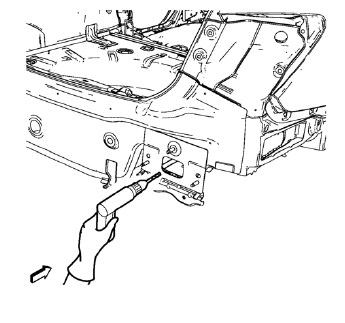
- Locate and mark all the necessary factory welds of the rear bumper impact bar stud plate.
Note: Note the number and location of welds for installation of the service assembly.
- Drill all factory welds.
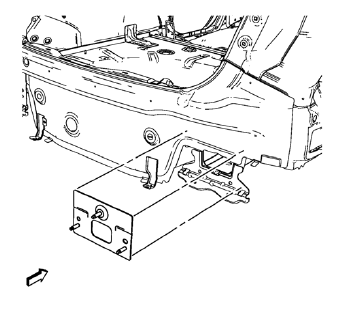
- Remove the rear bumper impact bar stud plate.
 Rear Bumper Impact Bar Stud Plate Replacement (MAG-Welding)
Note: According to different corrosion warranties, only the
regional mandatory joining methods are allowed. ...
 Installation Procedure
Drill 8 mm (5/16 in) for plug welding along the edges of the rear bumper
impact bar stud plate as noted from the original panel.
Note: If the location of the original plug weld holes can ...
Other materials:
Infotainment
Read the following pages to become familiar with the audio system's features.
WARNING
Taking your eyes off the road for extended periods could cause a crash resulting
in injury or death to you or others. Do not give extended attention to infotainment
tasks while driving.
This system provi ...
How To Indentify Plastic Parts
Plastic parts can be identified by the SAE code, which is usually found on
the rear of the part, and/or by the characteristics of the plastic.
Knowing the type of plastic aids in selecting the proper repair materials and in
selecting the proper repair procedure.
Look for the SAE code s ...
Installation Procedure
Align the rear compartment floor panel.
Drill 8 mm (5/16 in) for plug welding along the edges of the rear compartment
floor panel as noted from the original panel.
Clean and prepare the attaching surfaces for
welding.
Position the rear compartment floor panel on the vehicle.
V ...
