
Chevrolet Cruze Repair Manual: Shock Absorber Replacement
Removal Procedure
- Raise and suitably support the vehicle. Refer to Lifting and Jacking the Vehicle.
- Remove the tire and wheel assembly. Refer to Tire and Wheel Removal and Installation.
- Support the rear axle with a tall jack stand near the shock absorber.
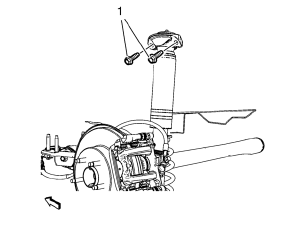
- Remove the upper shock absorber bolts (1).
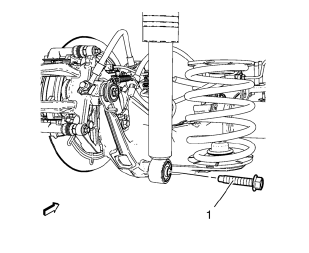
- Remove the lower shock absorber bolt (1).
Installation Procedure
- Position the shock absorber to the vehicle.
Caution: Refer to Fastener Caution in the Preface section.
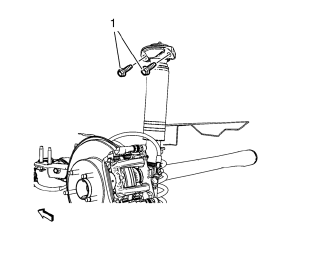
- Install NEW upper shock absorber bolts (1) and tighten to 100 N·m (74 lb in).
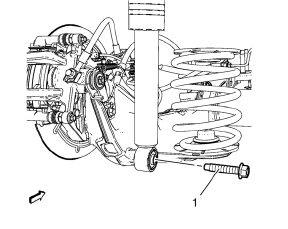
- Install NEW lower shock absorber bolt (1) and tighten to 150 N·m (111 lb ft) + 60°.
- Remove the jack stand.
- Install the rear tire and wheel assembly. Refer to Tire and Wheel Removal and Installation.
- Lower the vehicle.
 Rear Axle Bushing Replacement
Special Tools
CH 6616 Hydraulic Hand Pump
CH 6615-10 Hydraulic Cylinder
CH-48377-1 Chisel
CH-49233 Adapter
CH 906-42 Adapter
For equivalent regional tools. Refer to Special Tools
Remov ...
 Shock Absorber Disposal
Warning: Gas charged shock absorbers contain high pressure gas. Do
not remove the snap ring from inside the top of the tube. If the snap
ring is removed, the contents of the shock absorber will com ...
Other materials:
Safety Locks
The rear door safety locks prevent passengers from opening the rear doors from
inside the vehicle.
Press to activate the safety locks.
The indicator light comes on when activated.
The rear door power windows are also disabled.
Press again to deactivate the safety
locks and power windows ...
Exit Lighting
The headlamps, taillamps, parking lamps, back-up lamps, and license plate lamps
come on at night, or in areas with limited lighting, when the key is removed from
the ignition.
The dome lamps also come on when the key is removed from the ignition. The exterior
lights and dome lamps remain on a ...
Frame and Underbody
Specifications
Engine Shield Replacement
Preliminary Procedure
Raise and support the vehicle. Refer to Lifting and Jacking the Vehicle.
Engine Shield Bolt (Qty: 4)
Caution: Refer to Fastener Caution in the Preface section.
Tighten
40 N·m (30 lb ft)
Engine Shield
Front Comp ...
