
Chevrolet Cruze Repair Manual: Installation Procedure
- Prepare all mating surfaces as necessary.
- Align the front hinge pillar body reinforcement.
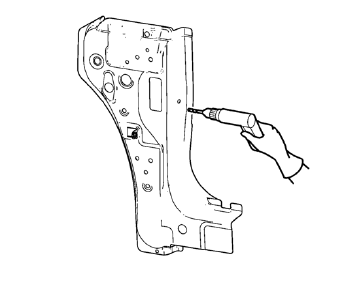
- Create 6 x 20 mm (4/16 x 12/16 in) slots for MIG-brazing in locations where you can not apply a resistance spot welder.
- Clean and prepare the attaching surfaces for spot welding and brazing.
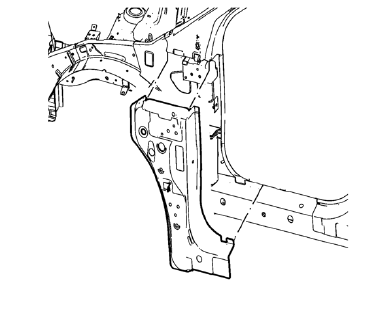
- Position the front hinge pillar body reinforcement on the vehicle.
- Verify the fit of the front hinge pillar body reinforcement.
- Clamp the front hinge pillar body reinforcement into position.
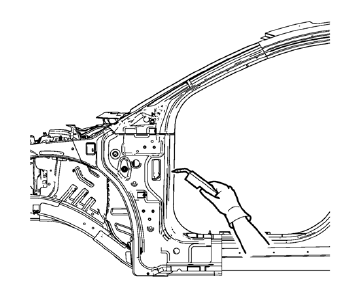
- Plug weld accordingly.
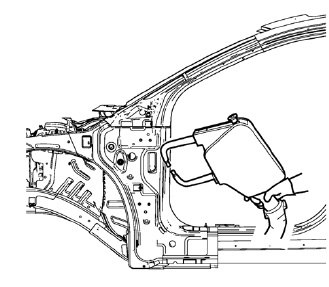
- Spot weld accordingly.
- Apply the sealers and anti-corrosion materials to the repair area, as necessary. Refer to Anti-Corrosion Treatment and Repair.
- Paint the repaired area. Refer to Basecoat/Clearcoat Paint Systems
- Install all related panels and components.
- Connect the negative battery cable. Refer to Battery Negative Cable Disconnection and Connection.
- Enable the SIR system. Refer to SIR Disabling and Enabling.
 Removal Procedure
Warning: Refer to Approved Equipment for Collision Repair Warning in the
Preface section.
Warning: Refer to Collision Sectioning Warning in the Preface section.
Warning: Refer to Glass and She ...
 Roof Outer Panel Replacement (MAG-Welding)
Note: According to different corrosion warranties, only the
regional mandatory joining methods are allowed ...
Other materials:
Infotainment
The names, logos, emblems, slogans, vehicle model names, and vehicle body designs
appearing in this manual including, but not limited to, GM, the GM logo, CHEVROLET,
the CHEVROLET Emblem, CRUZE, and the CRUZE logo are trademarks and/or service marks
of General Motors LLC, its subsidiaries, a ...
Tracing Powder or Chalk Test
Clean the weatherstrips and the contact surfaces with cleaning solvent.
Apply powder or chalk in an unbroken line to the contact surface of the
weatherstrip surrounding the perimeter of the suspected
areas.
Close the panel completely without slamming the panel. Closing the panel
comple ...
Heated Oxygen and Oxygen Sensor Caution
Caution: Do not remove the pigtail from either the heated oxygen
sensor (HO2S) or the oxygen sensor (O2S). Removing the pigtail or the
connector will affect sensor operation.
Handle the oxygen sensor carefully. Do not drop the HO2S. Keep the in-line
electrical connector and the louvered end fr ...
