
Chevrolet Cruze Repair Manual: Installation Procedure
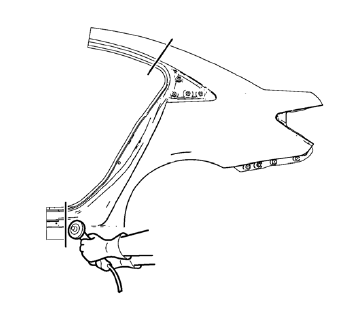
- Cut the quarter outer panel in corresponding locations to fit the remaining original panel. The sectioning joint should be trimmed to allow a gap of one-and-one-half-times the metal thickness at the sectioning joint.
- Create a 50 mm (2 in) backing plate from the unused portion of the service part.
- Create 5 x 18 mm (4/16 x 11/16 in) slots for MIG-brazing along the sectioning cut on the remaining original part. Locate these holes 13 mm (1/2 in) from the edge of part and spaced 40 mm (1 1/2 in) apart.
- Prepare all mating surfaces as necessary.
- Fit the backing plates halfway into the sectioning joints, clamp in place and braze to the vehicle.
- Align the quarter outer panel.
- Clean and prepare the attaching surfaces for spot welding.
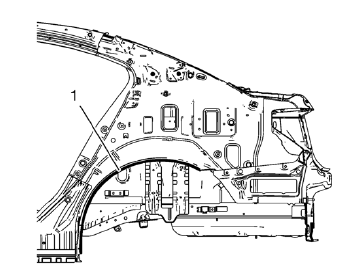
Note: In MIG-brazing areas 50 mm (2 in) must be kept clear of structural adhesive.
- Apply structural adhesive in the wheelhouse area (1) as noted from the original panel and to all attaching surfaces.
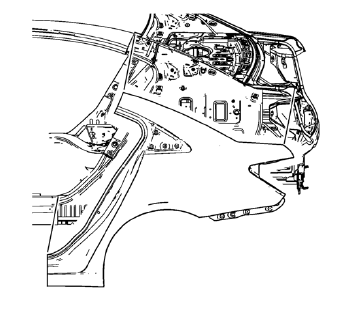
- Position the quarter outer panel on the vehicle.
- Verify the fit of the quarter outer panel.
- Clamp the quarter outer panel into position.
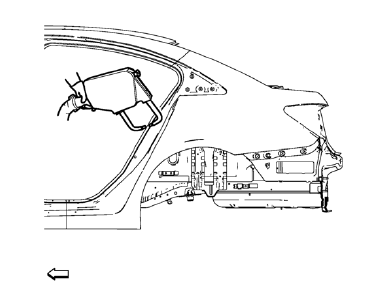
- Spot weld accordingly.
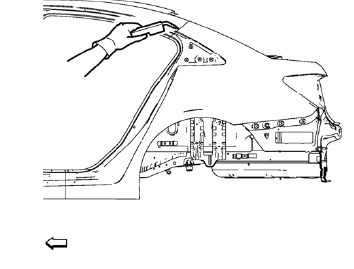
- Braze accordingly.
- To create a solid braze with minimum heat distortion, make 25 mm (1 in) stitch brazes along the seam with 25 mm (1 in) gaps between them. Then go back and complete the stitch braze.
- Pre-flanging the flange with BO-6396 pliers and BO-6392 tool kit .
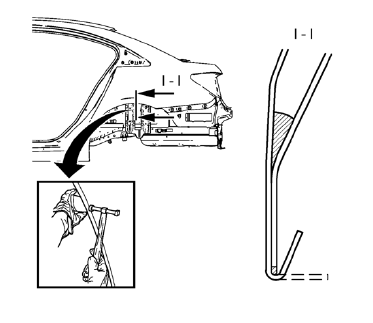
- Finish closing the wheelhouse flanging.
- Apply the sealers and anti-corrosion materials to the repair area, as necessary. Refer to Anti-Corrosion Treatment and Repair.
- Paint the repaired area. Refer to Basecoat/Clearcoat Paint Systems.
- Install all related panels and components.
- Connect the negative battery cable. Refer to Battery Negative Cable Disconnection and Connection.
- Enable the SIR system. Refer to SIR Disabling and Enabling.
 Removal Procedure
Warning: Refer to Approved Equipment for Collision Repair Warning in the
Preface section.
Warning: Refer to Collision Sectioning Warning in the Preface section.
Warning: Refer to Glass and She ...
 Body Rear End Panel Replacement (MAG-Welding)
Note: According to different corrosion warranties, only the
regional mandatory joining methods are allowed. ...
Other materials:
Door Locks
To lock or unlock the vehicle from outside, use the Remote Keyless Entry (RKE)
transmitter or the key.
From inside the vehicle, use the power door lock switch.
Power Door Locks
: Press to unlock the doors.
: Press to lock the doors.
Safety Locks
The rear door safety locks prevent passenge ...
Driving on Wet Roads
Rain and wet roads can reduce vehicle traction and affect your ability to stop
and accelerate.
Always drive slower in these types of driving conditions and avoid driving through
large puddles and deep-standing or flowing water.
WARNING
Wet brakes can cause crashes.
They might not work as wel ...
Where to Put the Restraint
According to accident statistics, children and infants are safer when properly
restrained in a child restraint system or infant restraint system secured in a rear
seating position.
We recommend that children and child restraints be secured in a rear seat, including:
an infant or a child ridin ...
