
Chevrolet Cruze Repair Manual: Installation Procedure
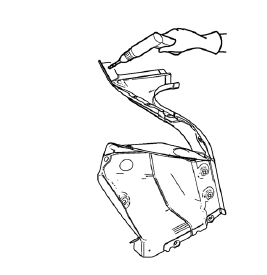
- Create 5 x 18 mm (4/16 x 11/16 in) slots for MIG-brazing along the edges of the tail lamp pocket as noted f rom the original panel.
Note:
- Clean and prepare the attaching surfaces for brazing.
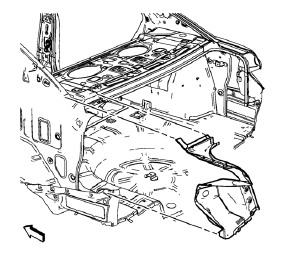
- Position the tail lamp pocket on the vehicle.
- Verify the fit of the tail lamp pocket.
- Clamp the tail lamp pocket into position.
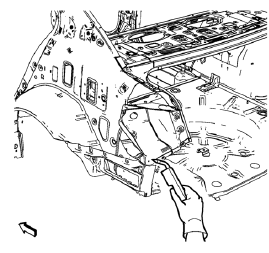
- Braze accordingly.
- Apply the sealers and anti-corrosion materials to the repair area, as necessary. Refer to Anti-Corrosion Treatment and Repair.
- Paint the repaired area. Refer to Basecoat/Clearcoat Paint Systems.
- Install all related panels and components.
- Connect the negative battery cable. Refer to Battery Negative Cable Disconnection and Connection.
- Enable the SIR system. Refer to SIR Disabling and Enabling.
 Removal Procedure
Warning: Refer to Approved Equipment for Collision Repair Warning in the
Preface section.
Warning: Refer to Glass and Sheet Metal Handling Warning in the Preface section.
Disable the SIR Syst ...
 Dual Phase Steel
This information provides repair recommendations and general guidelines for
steel classified as Dual Phase Steel (Dual Phase Steel with a
tensile strength up to and including 800 MPa), also known a ...
Other materials:
Installation Procedure
Install NEW stabilizer shaft insulators (1) to stabilizer shaft (2) so
that the slit in the insulator is facing the rear of the vehicle.
Install the insulator c 2. lamp to the insulator:
2.1. Position the clamp (2) over on the insulator.
2.2. Use two M8 bolts (1, 3) with 40 ...
Front Wheel Drive Shaft Replacement - Left Side
Special Tools
CH-313 Slide Hammer
CH-6003 Axle Shaft Remover
CH-46376 Holding Wrench
CH-49400 Hub Spindle Remover
DT-6332 Seal Protector
EN-956-1 Extension
For equivalent regional tools, refer to Special Tools.
Removal Procedure
Warning: To prevent personal injury and/or component ...
Instrument Panel Assembly Replacement
Preliminary Procedures
Disable the SIR system. Refer to SIR Disabling and Enabling
Remove the front floor console assembly. Refer to Front Floor Console
Replacement.
Remove the radio assembly. Refer to Radio Replacement.
Remove the driver information display bezel. Refer ...
