
Chevrolet Cruze Repair Manual: Installation Procedure
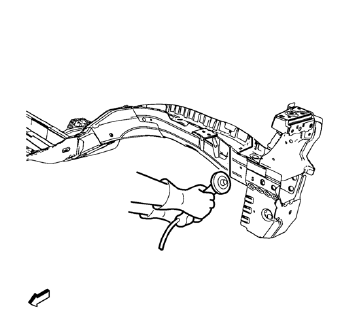
- Cut the front compartment front rail in corresponding locations to fit the remaining original panel. The sectioning joint should be trimmed to allow a gap of one-and-one-half-times the metal thickness at the sectioning joint.
- Create a 50 mm (2 in) backing plate from the unused portion of the service part.
Note: Place backing plate only in areas where adequate space is available.
- Create 5 x 18 mm (4/16 x 11/16 in) slots for MIG-brazing along the sectioning cut on the remaining original part. Locate these holes 13 mm (1/2 in) from the edge of part and spaced 40 mm (1 1/2 in) apart.
- Prepare all mating surfaces as necessary.
- Fit the backing plates halfway into the sectioning joints, clamp in place and braze to the vehicle.
- Align the front compartment front rail.
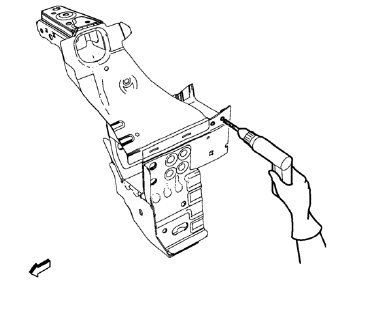
Note: Left side only.
- Create 6 x 20 mm (4/16 x 12/16 in) slots for MIG-brazing along the edges of the front compartment front rail as noted from the original panel.
- Clean and prepare the attaching surfaces for brazing.
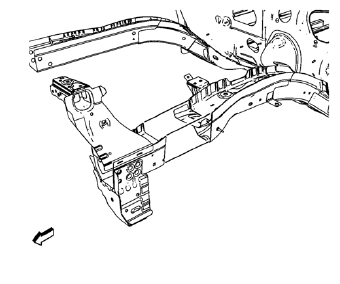
- Position the front compartment front rail on the vehicle.
- Verify the fit of the front compartment front rail.
- Clamp the front compartment front rail into position.
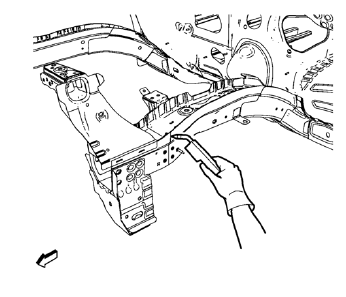
- Braze accordingly.
- To create a solid braze with minimum heat distortion, make 25 mm (1 in) stitch brazes along the seam with 25 mm (1 in) gaps between them. Then go back and complete the stitch braze.
- Apply the sealers and anti-corrosion materials to the repair area, as necessary. Refer to Anti-Corrosion Treatment and Repair.
- Paint the repaired area. Refer to Basecoat/Clearcoat Paint Systems.
- Install all related panels and components.
- Connect the negative battery cable. Refer to Battery Negative Cable Disconnection and Connection.
- Enable the SIR system. Refer to SIR Disabling and Enabling.
 Removal Procedure
Warning: Refer to Approved Equipment for Collision Repair Warning in the
Preface section.
Warning: Refer to Collision Sectioning Warning in the Preface section.
Warning: Refer to Glass and She ...
 Front Hinge Pillar Body Sectioning (MAG-Welding)
Note: According to different corrosion warranties, only the
regional mandatory joining methods are allowed. ...
Other materials:
SIR System Description and Operation
SIR System Overview
The supplemental inflatable restraint (SIR) system supplements the protection
offered by the occupants Seat Belt System (2). The SIR
system may contain several inflator modules located throughout the vehicle, i.e.
steering wheel module (1), instrument panel module (1),
...
Rear Compartment Lid Weatherstrip Replacement
Rear Compartment Lid Weatherstrip
Procedure
Start at the upper corner of the rear compartment opening and pull the
weatherstrip away from the rear
compartment opening flange.
Position the weatherstrip in the upper corner of the r 2. ear
compartment opening.
Working downward alon ...
Engine Oil
To ensure proper engine performance and long life, careful attention must be
paid to engine oil.
Following these simple, but important steps will help protect your investment:
• Always use engine oil approved to the proper specification and of the proper viscosity
grade. See “Selecting the Ri ...
