
Chevrolet Cruze Repair Manual: Removal Procedure
Warning: Refer to Approved Equipment for Collision Repair Warning in the Preface section.
Warning: Refer to Glass and Sheet Metal Handling Warning in the Preface section.
- Disable the SIR System. Refer to SIR Disabling and Enabling.
- Disconnect the negative battery cable. Refer to Battery Negative Cable Disconnection and Connection.
- Remove all related panels and components
- Visually inspect the damage. Repair as much of the damage as possible.
- Remove the sealers and anti-corrosion materials from the repair area, as necessary. Refer to Anti-Corrosion Treatment and Repair.
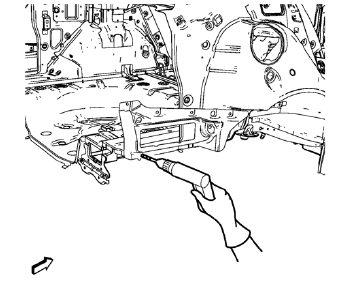
- Locate and mark all the necessary factory welds of the body side outer lower panel.
Note: Note the number and location of welds for installation of the service assembly.
- Drill all factory welds.
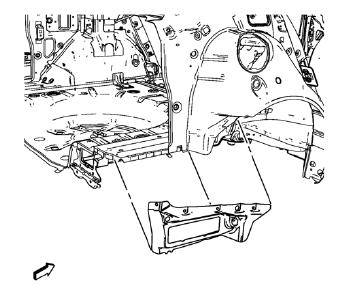
- Remove the body side outer lower panel.
 Body Side Outer Lower Panel Replacement (MAG-Welding)
Note: According to different corrosion warranties, only the
regional mandatory joining methods are allowed. ...
 Installation Procedure
Drill 8 mm (5/16 in) for plug welding along the edges of the body side
outer lower panel as noted from the original panel.
Note: If the location of the original plug weld holes can not be ...
Other materials:
Outback Gets Turbo Boost and XT Badge Returns in Australia
Subaru Australia is giving the 2023 Outback a shot of adrenaline with the introduction of the turbocharged Outback XT. This new variant injects a much-needed dose of power into the popular wagon, addressing the loss of the 3.6-liter engine from the previous generation.
Under the hood of the car ...
Antilock Brake System (ABS)
This vehicle has the Antilock Brake System (ABS), an advanced electronic braking
system that helps prevent a braking skid.
When the vehicle begins to drive away, ABS checks itself.
A momentary motor or clicking noise might be heard while this test is going on,
and it might even be noticed that ...
Front Side Door Weatherstrip Replacement - Body Side
Front Side Door Weatherstrip - Body Side
Procedure
Start at the rear upper corner of the door opening and pull the
weatherstrip away from the door opening flange.
Position the weatherstrip in the upper corner of the center pillar.
Working downward along the front edge, in ...
