
Chevrolet Cruze Repair Manual: Forward Lamp Wiring Harness Replacement
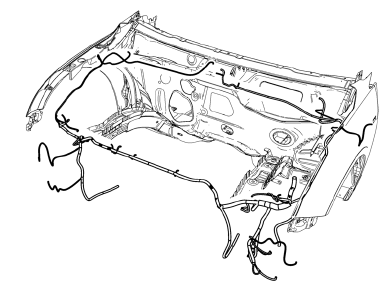
Preliminary Procedures
- Remove the front bumper. Refer to Front Bumper Fascia Replacement.
- Remove the headlamp. Refer to Headlamp Replacement.
- Using a scan tool, check for DTCs.
Forward Lamp Wiring Harness
Tip
- Create a work area large enough to lay out the new and old wiring harnesses.
- Use care when removing inaccessible harness retainers. Replacement retainers may not be available.
- Compare the new and old wiring harnesses for the same part number, the same number of wiring harness connectors, the same pin settings, and the same harness retainers.
- Follow a logical order of steps during the replacement to ensure proper installation of the harness.
Rear License Plate Lamp Replacement
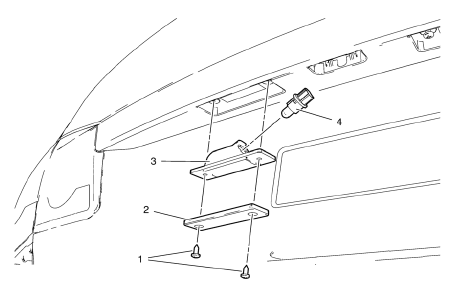
- Rear License Plate Lamp Screw (Qty: 2)
Caution: Refer to Fastener Caution in the Preface section.
Tighten 3 N·m (27 lb in)
- Rear License Plate Lamp
Tip
Rotate the left corner of the lamp assembly upward and pull the right side down out from the rear bumper fascia opening.
- Rear License Plate Lamp Socket
Tip
Rotate the lamp socket counterclockwise and remove.
- Rear License Plate Lamp Bulb
Tip
Service the bulb, as needed.
 Backup Lamp Replacement
Preliminary Procedures
Remove the rear compartment sill trim plate. Refer to Rear Compartment
Sill Trim Plate Replacement.
Disconnect the electrical harness connector from the backu ...
 Tail Lamp Replacement
Preliminary Procedures
Open and support the rear compartment
lid.
Remove the body side trim panel replacement in order to expose the tail
lamp pocket nuts. Refer to Body Side Tr ...
Other materials:
Cruise Control
For vehicles with cruise control, the vehicle can maintain a speed of about 40
km/h (25 mph) or more without keeping your foot on the accelerator. Cruise control
does not work at speeds below 40 km/h (25 mph).
If the brakes are applied, the cruise control shuts off.
The vehicle has a Traction ...
Door Locks
WARNING
Unlocked doors can be dangerous.
• Passengers, especially children, can easily open the doors and fall out of
a moving vehicle. The chance of being thrown out of the vehicle in a crash is increased
if the doors are not locked. So, all passengers should wear safety belts properly
and ...
Removal Procedure
Support the radiator and condenser from above using the
condenser tabs on each side.
Remove the lower steering intermediate shaft bolt (1).
Raise the vehicle on a hoist. Refer to Lifting and Jacking the Vehicle.
Remove the tire and wheel assemblies. Refer to Tire and Wheel Remov ...
