
Chevrolet Cruze Repair Manual: Removal Procedure
Warning: Refer to Approved Equipment for Collision Repair Warning in the Preface section.
Warning: Refer to Glass and Sheet Metal Handling Warning in the Preface section.
- Disable the SIR System. Refer to SIR Disabling and Enabling.
- Disconnect the negative battery cable. Refer to Battery Negative Cable Disconnection and Connection
- Remove all related panels and components.
- Visually inspect the damage. Repair as much of the damage as possible.
- Remove the sealers and anti-corrosion materials from the repair area, as necessary. Refer to Anti-Corrosion Treatment and Repair.
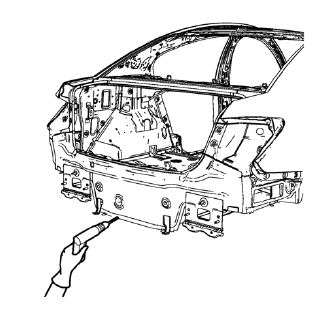
- Locate and mark all the necessary factory welds of the body rear end panel.
Note: Note the number and location of welds for installation of the service assembly.
- Drill all factory welds.
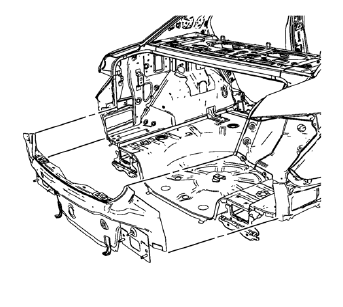
- Remove the body rear end panel.
 Body Rear End Panel Replacement (MAG-Welding)
Note: According to different corrosion warranties, only the
regional mandatory joining methods are allowed. ...
 Installation Procedure
Note: If the location of the original plug weld holes can not be
determined, space the plug weld holes every 40 mm (1½ in).
Drill 8 mm (5/16 in) for plug welding along the edges of th ...
Other materials:
Front End Upper Tie Bar Replacement
Preliminary Procedure
Remove the front bumper fascia. Refer to Front Bumper Fascia
Replacement
Remove the radiator support bracket. Refer to Radiator Support Bracket
Replacement
Remove the radiator grille reinforcement support. Refer to Radiator
Grille Reinforcement Suppor ...
High Strength Low Alloy Steel
This information provides repair recommendations and general guidelines for
steel classified as High Strength Low Alloy Steel, also known
as HSLA. This type of steel normally has a tensile strength range from 300-700
MPa.
General Motors recommends the following when repairing or replacing th ...
Auxiliary Devices
If equipped, the AUX inputs are in the center console and allows portable devices
to connect to the vehicle using the 3.5 mm(1/8 in) auxiliary jack or USB port.
3.5mm Jack
Connect a 3.5mm (1/8 in) cable to the auxiliary input jack to use a portable
audio player.
Playback of an audio device th ...
